https://vimeo.com/139833906
Thanks to talented Pomaikai Elementary teacher Donelle Sakuma for creating this same-day vimeo of our Island Energy Inquiry workshop, part of the educational offerings of the Ka Hei program state-wide. Watch for IEI workshops coming to your islands!

Wednesday, September 23, 2015

Monday, September 14, 2015
Working with Maui Electric towards energy prosperity
Our Island Energy Inquiry team worked alongside Maui Electric Company at their Electric Energy Fair to help families discover the path to energy prosperity. Can you hand-crank our turbine and convert it to a table fan?


Monday, August 10, 2015
Blog Feedback
Aloha Island Energy Inquiry (IEI) Blog Readers,
The MEDB Island Energy Inquiry team would greatly appreciate your help in obtaining feedback regarding the popularity of the IEI blog. If you would like to continue reading posts from our Island Energy Inquiry team, please email Melinda White at melinda@medb.org. Please feel free to let us know what topics you would be interested in for future posts.
We hope to hear from you!
Mahalo!
The MEDB Island Energy Inquiry team would greatly appreciate your help in obtaining feedback regarding the popularity of the IEI blog. If you would like to continue reading posts from our Island Energy Inquiry team, please email Melinda White at melinda@medb.org. Please feel free to let us know what topics you would be interested in for future posts.
We hope to hear from you!
Mahalo!
Thursday, April 23, 2015
STEM Success: For all?
Rocket Scientist Syndrome
I enjoyed Alfred Hall’s commentary (April/May 2015 The
Science Teacher). He’s done a nice job of showing the importance of
educating STEM students—both the ‘best and brightest’ and everyone else.
My reasons for agreeing are more social than strictly
educational. I actually became a 17-year science teacher because of what
I saw during a 19-year career as an engineering manager and executive. I
was dismayed at how ‘uncool’ it had become for American students to embrace
science and engineering. I hired many young engineers, and increasingly
they’d been educated abroad and had come to America to fill our gaping need for
technical professionals. Where were our own professionals?
Taking college campus tours with our son, I would hear our
campus tour guides pointing out the dorms, library, or campus performing arts
center with pride. Then we’d pass the engineering school (at a distance)
and the guide would say, in effect, “There’s the engineering school. We
see the freshmen disappear there and show up at graduation…we have no idea what
happens to them in between.” The not-subtle message steers young people
away from STEM—almost horrifying them.
As a science teacher then, I had a combined mission.
Rather than try to turn everyone into scientists, I instead wanted them to
appreciate the possible ‘cool-ness’ of the sciences. I got everyone in
our class doing science, asking and answering their own questions, learning the
way scientists learn. But my message was straightforward.
Science (STEM) is not for everyone. We want those who
have the natural STEM talent and disposition to understand that a technical
career can be very cool, enjoyable and rewarding. We want another tier of
mechanically-gifted people to enjoy becoming technicians, mechanics,
experimenters and to know their talents are valued and rewarded by society.
And we want everyone else—the artists, actors, poets, historians,
accountants—to be comfortable knowing and working with ‘nerds’ because we are
not nearly so nerdy as we seem, and we’re actually doing cool things that all
students can and should experience in middle and high school.
Lately, I’ve been concerned with the backlash that STEM is
starting to get, as STEM programs succeed in attracting funding and student
interest. Schools want to add Arts to STEM, making it STEAM. And
add reading skills (STREAM) and maybe music (STREAMM?) because educators worry
there’s a big pendulum in education that can only swing one way or the
other. False! We’re not trying to grab humanities students and
force them into STEM pathways. That would be crazy. We just need to
create awareness among all our students on how to either pursue STEM careers
(with the natural disposition of those few students and with society’s approval
of them) or pursue totally different fields (with a clear fondness for their
STEM sisters and brothers).
This is a paragraph I sent home to parents each year as a
science teacher:
We need to be a society with members capable to figure things out and make
things work—to produce. Our courses in science and math help prepare some
specialists for their further technical training, and help the rest of society
understand the part played by scientists, engineers, and technicians.
Similarly, our science majors need to know that building a physical framework
is only a part of society’s output. Cars, spaceships, computers, and
particle accelerators are all tools and devices that serve us while we also
advance arts, culture, philosophy, religion, or even entertainment and
recreation. Students in my courses will hear my views of where their classes
fit into their portfolio of understanding.

Tuesday, March 24, 2015
Electric Future! Attend an Open House Near You...
The Hawaiian Electric Companies and NextEra will be meeting with your community to share ideas for the state's energy future. You are invited! All times are 5 to 8 PM at the locations shown here.

Monday, March 9, 2015
Hawaii's Warm Sun
These are illustrations within a new IEI module for Kindergarten, titled "Hawaii's Warm Sun" which bases the NGSS standards for grade K on energy we use from the sun in Hawaii. In this lab activity, students explore the effects of bright sunlight on colors of construction paper.


Kaua`i Training Photos
Our teachers on Kaua`i are documenting their inquiry learning through iPad photos. This group was learning Island Energy Inquiry as part of the Ka Hei statewide project with our partners OpTerra Energy Services.

Wednesday, January 7, 2015
Ka Hei Project brings IEI back to Kaua`i


This IEI workshop at Kaua`i Community College was hosted by OpTerra Energy Systems as part of the Ka Hei project now being piloted. During part of our studies, we worked with Bob Conti, one of the state's top training resources in solar energy and a great friend of the program. Check out the flow of water from the pump that Bob is powering with a Photovoltaic panel!
Tuesday, September 16, 2014
Young scientists explore wind power!

Tuesday, September 9, 2014
Asia experiences IEI!
Our IEI team shared methods during a pilot project in Bangkok, and our Thai students love learning.
Monday, July 14, 2014
Harnessing the sun?
What variables affect the power we can take from sunlight with PV panels in series? In parallel? Our teachers learn for themselves (as scientists do) during our Oahu workshop on June 26-27.


Friday, June 20, 2014
Maui Teachers Modify Their Experiments
What variable will you choose to test? Does your new data support our hypothesis? Teachers modify experiments to test variables and defend their results...

Monday, May 12, 2014
Tell your teaching friends: IEI workshops this summer!

Thursday, March 6, 2014
Compete, thanks to KidWind!
Our alert IEI teacher Carmen noticed an international competition that KidWind is sponsoring:
http://challenge.kidwind.org/online
Your students can form a team and send in their results for a KidWind turbine they design. Carmen's team, "Team Gold" have entered next month's competition already. Good luck!
http://challenge.kidwind.org/online
Your students can form a team and send in their results for a KidWind turbine they design. Carmen's team, "Team Gold" have entered next month's competition already. Good luck!
Friday, February 14, 2014
A first light for the globe?
Our friend Charles Wang of Hawaii ECO Project has shared with us a working prototype of Panasonic's LED Lantern. This self-contained system will use sunlight to directly charge a high-tech battery--storing enough energy for five hours of bright light or twenty at a reduced-light setting. Many humans on our globe have never owned a light bulb, and this would be an amazing way for them to enjoy their first light!

Wednesday, January 29, 2014
An Energy Poem from Waiupahu!
Our IEI teacher Kathy Duhaylongsod of Waipahu Elementary sent us this poem from her 5th graders. Clever teacher!
Energy
Here, Energy There
Energy here, energy
there,
Energy,
energy everywhere!
Wind
can transfer energy just
fine,
All
you need is a wind turbine!
A
turbine needs some wind to move,
And
turn those blades,
oh-so-smooth!
Like
our pinwheel
lifting some clips,
Turbines
make electricity in a zip!
Energy
here, energy there,
Energy,
energy everywhere!
Tuesday, January 28, 2014
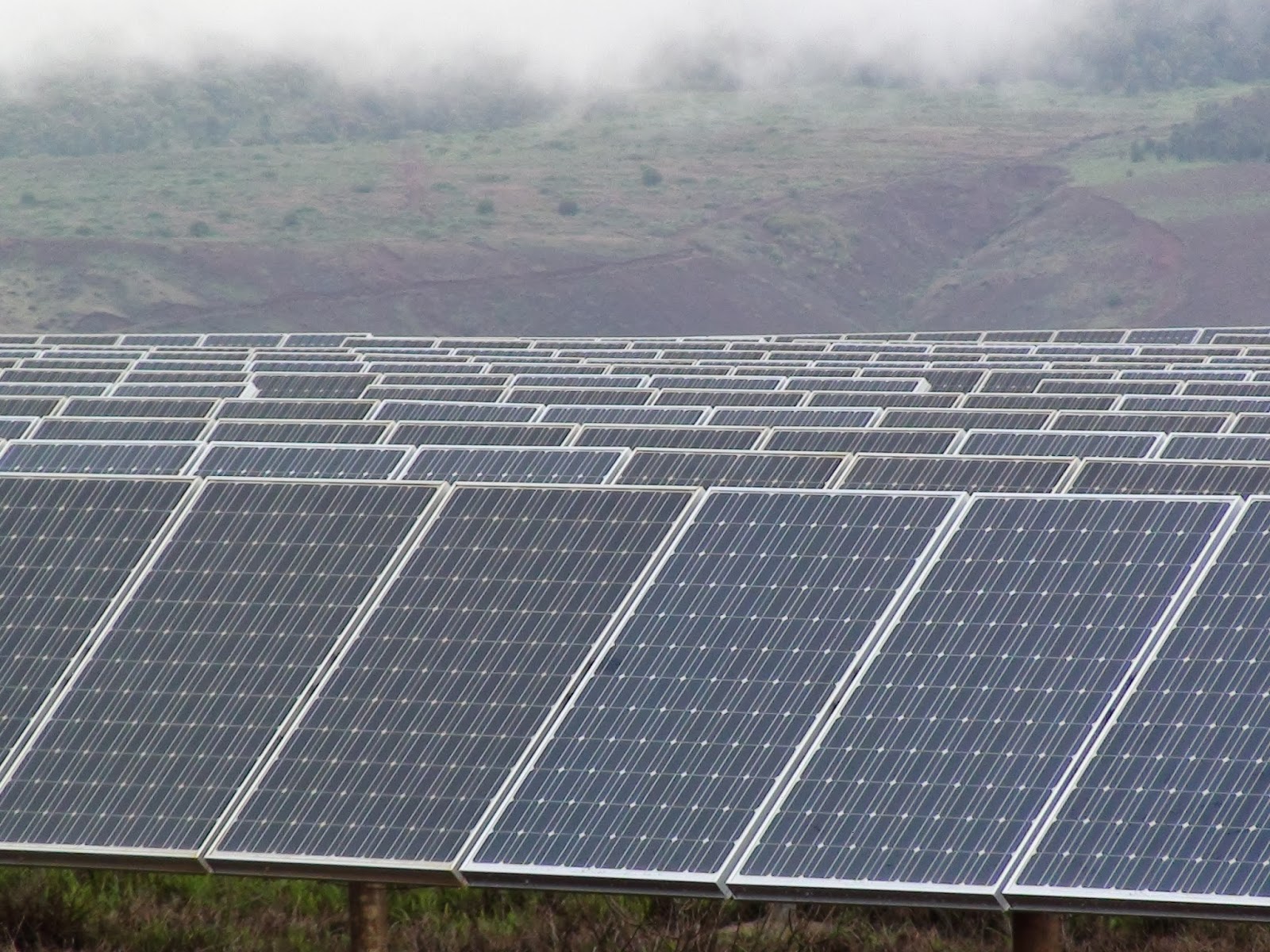
On Maui: What renewable energies are leading?
http://hightechmaui.com/maui-county-continues-to-lead-the-way-in-renewable-energy/ This link will take you to the latest data on important renewable energies on Maui. Solar? Wind? Geo? These and many more are clearly described and quantified by MEDB's High Tech Maui group.
Tuesday, January 21, 2014
Solar oven--Can you fry an egg?
http://www.billnye.com/so-hot-you-could-fry-an-egg/
Here's a link to a Bill Nye site that gives tips on how to fry an egg using your solar oven. You'll need to get to about 55 Celsius or 130 Fahrenheit. It's fun! Show your students?
Here's a link to a Bill Nye site that gives tips on how to fry an egg using your solar oven. You'll need to get to about 55 Celsius or 130 Fahrenheit. It's fun! Show your students?
Wednesday, January 8, 2014
Social media in seven minutes: Share with students
Here's a link showing how critical skills in social media have become. Give it a look and share with your students; this is the world we can help them prepare to enter.
http://www.youtube.com/watch?v=5mid8p4A6Eg&feature=youtu.be
http://www.youtube.com/watch?v=5mid8p4A6Eg&feature=youtu.be
Monday, January 6, 2014
Sun, and wind!
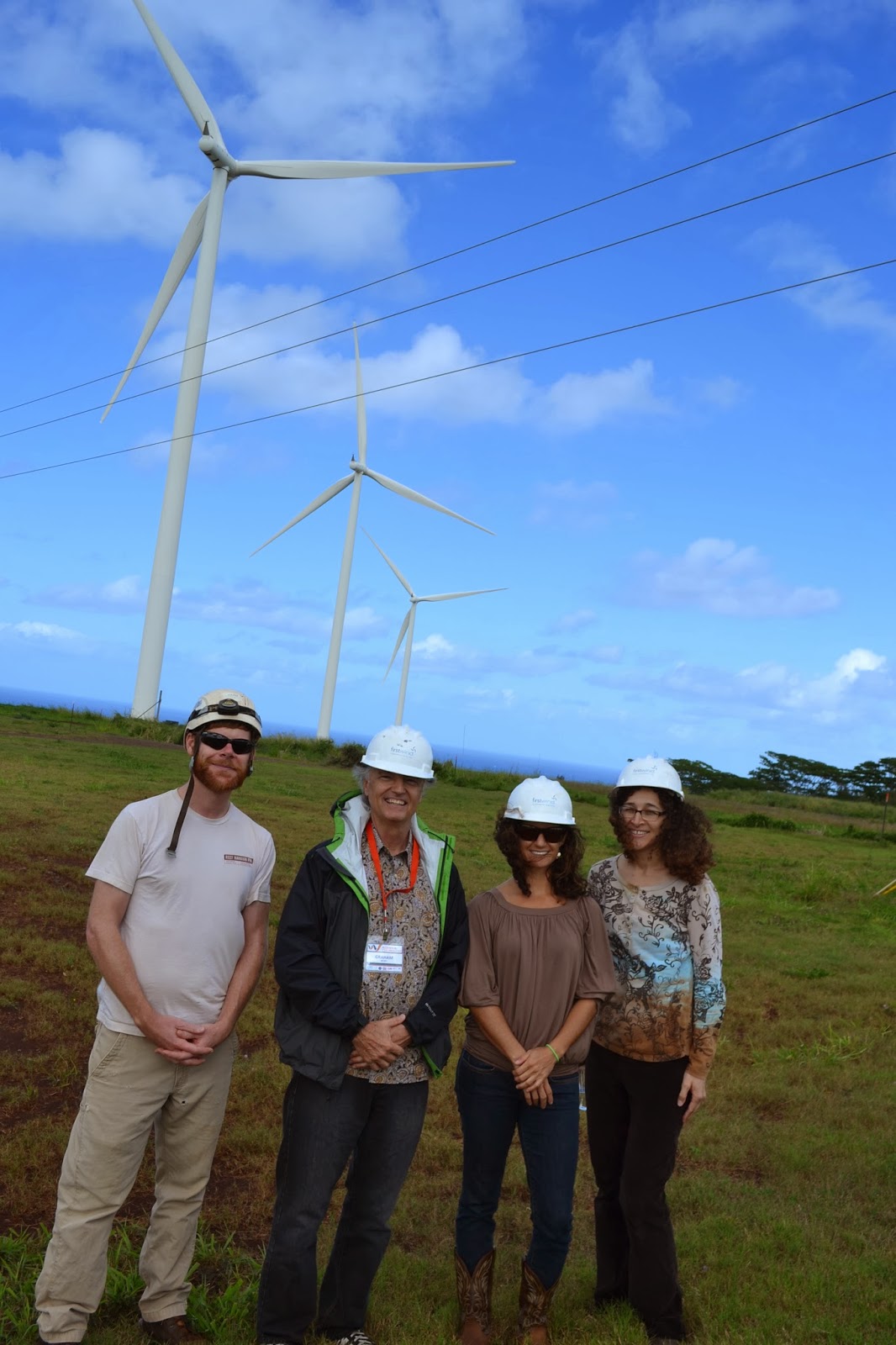
We had a sunny day to visit Kawailoa Wind Farm with our friends from First Wind, Adam Young and Carolyn Unser. Sun, wind, great views, and amazing technology!

Our visiting teachers on Oahu will have a lot to share with their students. Newest blade designs minimize sound and boost performance. These are 2 . 3 megawatt (million watt) turbines!
Subscribe to:
Posts (Atom)